



















FAQ / Frequently Asked Questions

How to choose a dog trainer?
When you’re researching dog trainers, ask them questions! If a dog trainer can’t clearly and specifically tell you how effective they are at improving the behavior of the dogs they work with, or if they can’t tell you their success rates…look elsewhere.
Most dog trainers ask you to pay upfront for “packages” of 8 to 10 sessions (on average). Yet those same trainers can’t, or won’t, tell you what their success rates are with their clients.
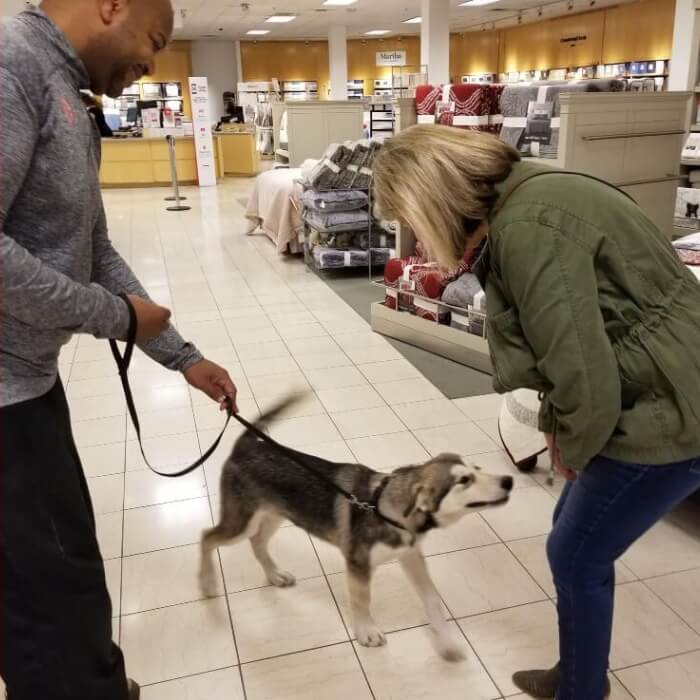
Many of Sura Dog Training’s clients tell us that before they came to us, they had taken their dog to other trainers for 10 sessions and saw no improvement. But during and after ONE session with us, their dog’s behavior issues noticeably improved.
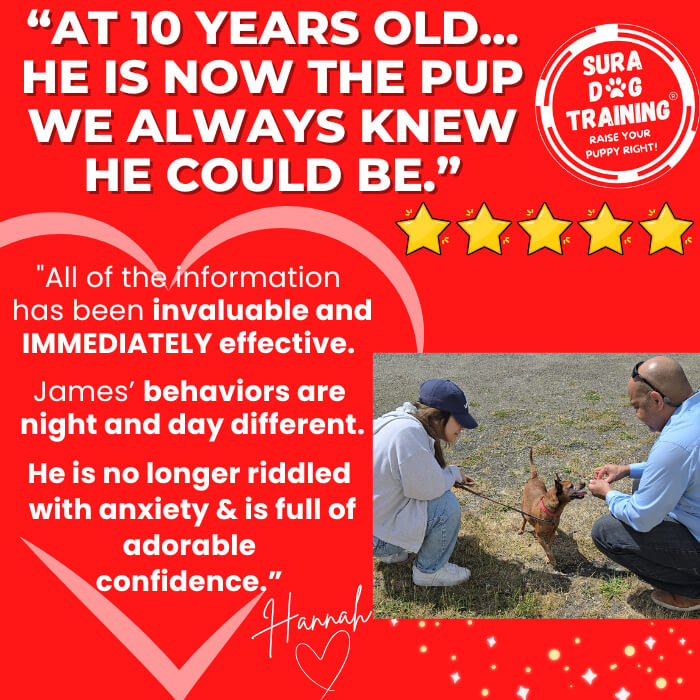
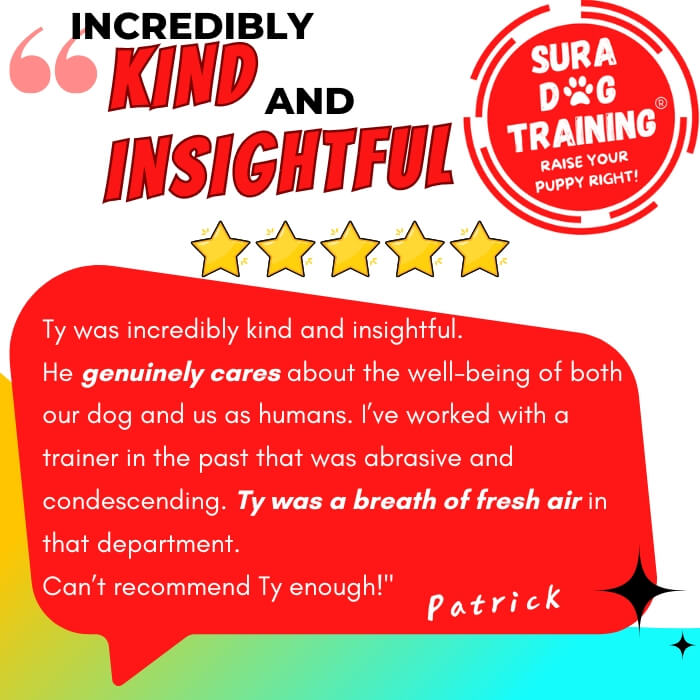
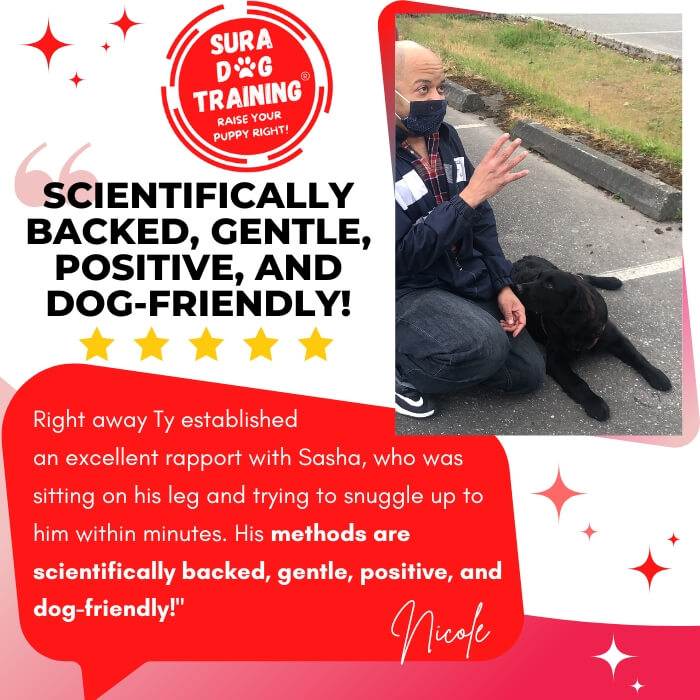
Don’t take our word for it–read our stellar Google reviews to hear directly from our clients.
What breeds of dogs do you work with?
At Sura Dog Training, all breeds are welcome! Unlike some dog trainers out there, we understand that breed does not dictate a dog’s behavior, and it also doesn’t stop any dog from learning a better way. We are happy to work with all breeds and sizes of dogs.
We know that there are no bad dogs. It’s all about what they have or haven’t been taught.
Do you work with ___ dog breed?
Yes! No matter what breed or mix of breeds your dog is, all breeds are welcome at Sura Dog Training.
We know that there are no bad dogs. It’s all about what they have or haven’t been taught.
Are Sura Dog Training’s methods reward-based?
Absolutely! Everything we do at Sura Dog Training is Free From Force, Pain, And Fear, and we advocate for your dog. Our Certified Professional Dog Trainer and Dog Behavior Problem Counselor, Ty Tate, is mentored by Dr. Ian Dunbar, a legendary dog trainer and behaviorist who revolutionized the entire field of dog and animal training. Our reward-based training methods are quick, easy, effective, backed by science, and always dog-friendly. In fact, our methods are so easy and safe that an 8-year-old child can use them!
Watch our video that summarizes how we train dogs:
What do you mean when you say 96% of your clients only need one session?
At Sura Dog Training, we are pet parents first and foremost. We know from firsthand experience what it’s like to deal with upsetting dog behavior issues and we understand that you need help immediately.
Armed with our professional experience and science-based education about dog behavior, cognition, and learning, we tailor a training plan specific to each dog that will work for the pup and the dog’s human family.
Plus, our methods are so easy and safe that an 8-year-old child can use them!
We train your dog and achieve visible improvement in your dog’s behavior during ONE SESSION. We also teach you, the pet parent, how to continue that progress with your dog in everyday life.
That’s why 96% of our clients see such clear improvement in their dog’s issues that they’re satisfied after only a single session with us (rather than 10 sessions as you’ll find with many other trainers.)

Does your 96% single session success rate include reactive dogs?
Yes! Out of ALL of our clients, including reactive, stressed, and anxious dogs, 96% see noticeable improvement after a single session.
Why don’t you offer board and train?
One word: Science.
We do in-person training sessions for pet dogs rather than board and train because scientific research shows that dogs do not generalize well. That means the dog’s behavior may be entirely different in a new location with different people versus at home, especially if the owner isn’t part of the learning process. All of which increases the probability of the dog reverting back to their old bad habits and the owner being disappointed.
The best way for pet dogs to learn is alongside their owner, and the best way for the owner to learn is to be taught by the trainer alongside their dog. Aside from service dogs–who are bred, carefully selected, and trained from birth for special tasks–this is generally the most effective way to train. Even police and military dogs are trained side by side with their handlers.
In short: your dog lives with you, not the trainer. So you have to learn how to continue your dog’s improvement in your home, in everyday life.
We train your dog and achieve visible improvement in your dog’s behavior during ONE SESSION. We also teach you, the pet parent, how to continue that progress with your dog in everyday life.
SUCCESS IS NOT FOR A WEEK — IT’S FOR A DOG’S LIFETIME.
What is day training? And do you offer day training?
Day training is a relatively new term. Typically it refers to a service that’s a lot like board and train (see our insights about that board and train above): The pet parent drops off their dog with the trainer for the day and is absent from whatever is happening between the trainer and their dog. Then the pet parent picks up their dog at the end of the day. Generally, like most dog training you see out there, day training is sold to the pet parent in “packages” so that the pet parent is locked into a certain number of sessions.
The marketing around this term pushes the idea that “day training” means that the dog trainer is training the dog, not the dog owner. The idea, they say, is that the owner doesn’t want to, or shouldn’t have to, learn how to train their own dog.
Day training and board & train are often painted as magical solutions. The pet parent hands off their dog, don’t have to do anything with their dog themselves, and when they get their dog back, she’s perfectly behaved. Unfortunately, that’s not real life.
There are significant problems with this concept of “day training”:
- What happens after the day training ends and the pet parent is back home with their dog? Scientific research and modern understanding of canine cognition shows that dogs do not generalize well. That means the dog’s behavior may be entirely different in a new location with different people versus at home, especially if the owner isn’t part of the learning process. All of which increases the probability of the dog reverting back to their old bad habits and the owner being disappointed.
- Who benefits from the “day training” concept? Is it really good for the dog or the pet parent if the dog’s behavior is not better than it was before, or if the pet parent isn’t taught how to continue any progress the dog may have had while she was away? Or is “day training” really just a benefit for the trainer, who is being paid more for a “package” of multiple sessions?
The bottom line is this: No matter what your dog’s issues are that you want to change (or if you’re trying to prevent behavior problems), you must find a dog trainer who is EFFECTIVE at actually teaching and training your dog. If a dog trainer is spending hours on end with a dog and the dog is only making marginal improvements or his behavior isn’t noticeably better at all, there is a serious problem with that trainer.
The best way for pet dogs to learn is alongside their owners, and the best way for the owners to learn is to be taught by the trainer alongside their dogs. Aside from service dogs–who are bred, carefully selected, and trained from birth for special tasks–this is generally the most effective way to train any dog. Even police and military dogs are trained side by side with their handlers.
In short: your dog lives with you, not the trainer. So you have to learn how to continue your dog’s improvement in your home, in everyday life.
We train your dog and achieve visible improvement in your dog’s behavior during ONE SESSION. We also teach you, the pet parent, how to continue that progress with your dog in everyday life.
SUCCESS IS NOT FOR A DAY — IT’S FOR A DOG’S LIFETIME.
How do I book an in-person session with Sura Dog Training?
Easy! Complete our In-Person Training Application Form to tell us about your dog and the issues you need help with. You’ll hear back from us soon with next steps.
Is it safe for my puppy to be in classes before she’s finished all her puppy shots?
Not only is it safe for your puppy, the foremost dog behavior and training experts in the world state that puppies SHOULD be properly socialized and participate in puppy classes, particularly during the most critical period of puppy socialization (the first 12 weeks of age) — even though that means the puppies won’t be fully vaccinated yet. Essentially, the behavioral payoff is worth the relatively minor health risk.
The American Veterinary Society of Animal Behavior (AVSAB) states that “The primary and most important time for puppy socialization is the first three months of life. During this time puppies should be exposed to as many new people, animals, stimuli and environments as can be achieved safely and without causing overstimulation manifested as excessive fear, withdrawal or avoidance behavior. For this reason, the American Veterinary Society of Animal Behavior believes that it should be the standard of care for puppies to receive such socialization before they are fully vaccinated.”
Dr. Ian Dunbar, legendary dog trainer and veterinary behaviorist, revolutionized the entire field of dog and animal training and created the very first off-leash puppy classes in 1982. Dr. Dunbar states that since puppies in classes have received at least one puppy shot and the floors are sanitized, the risk of infection is quite low. In fact, in 30 years of conducting SIRIUS puppy classes, Dr. Dunbar has never seen a parvovirus infection spread in a class.
Why are your puppy classes off-leash?
We’ll let our mentor, Dr. Ian Dunbar, explain. Having created the very first off-leash puppy socialization and training classes in 1982, he is the world’s foremost expert!
“Puppy classes should be taught off-leash for the entire session (except, of course, when pups are learning to walk on leash). Puppies are off-leash at home and at the park, so you need to learn how to control your puppy off-leash, which obviously you cannot do if the pups are on-leash in class.
“Also, puppies need as much time as possible to play with other dogs (and so acquire solid bite inhibition and develop soft mouths) and to interact with every person in the room, especially men, children and strangers. They cannot do this if they are on-leash. Anytime spent sitting with your puppy on-leash and listening to a trainer talk is wasting precious socialization and training time.”
Does your Sura’s Solutions Dog Training On-Demand video course really work?
Yes! Our Sura’s Solutions Dog Training On-Demand video course began as a way to offer our clients a refresher from their In-Person Session. It became popular because each video offers step by step, how-to examples for common dog behavior problems that anyone can use even if they haven’t worked with Sura Dog Training before. Plus, you can tackle each topic on your own time, from anywhere.
Do Sura Dog Training Online Sessions really work?
Yes! We first began offering Online Training Sessions to help pet parents in 2020. Soon we had clients from all over the country coming to us for help.
In fact, our Online Puppy Class continues to be one of our most popular services!
Because we make the science of dog training easy and fun for both the pet parents and their dogs, our online services are highly effective. Plus, we will often show you impromptu demos with our own dogs!
What are Sura Dog Training’s hours of operation?
We’re closed on most major holidays. Please check our Google business listing for specific holiday hours.
- Sunday
- Closed
- Monday
- 10:00 am – 5:00 pm
- Tuesday
- 10:00 am – 5:00 pm
- Wednesday
- 10:00 am – 5:00 pm
- Thursday
- 10:00 am – 5:00 pm
- Friday
- 10:00 am – 5:00 pm
- Saturday
- 10:00 am – 12:00 pm
Join Our Mailing List:


